Announced September 9, 2026
Apple Health's VO2 max update in iOS 27
Short answer: Apple announced an at-home VO2 max estimate and Health Age inside a redesigned Health app. They are not available just because iOS 27 is installed: Apple says the redesign arrives later in 2026, begins in U.S. English, and requires an Apple Intelligence-enabled device.
Published September 10, 2026Last updated September 10, 2026By Archline Labs LLCEditorial methodology
What Apple actually announced
Apple's September 9 announcement extends Apple Intelligence into Health with a redesigned app, an Insights tab, and a Longevity tab. Two additions matter most for VO2 max:
Health Age adds context
Apple says Health Age will compare your metrics with your chronological age. It can draw on Apple Watch data including VO2 max, resting heart rate, sleep, and heart-rate variability, plus optional lab values such as A1c and LDL.
A guided estimate comes home
Apple describes an in-depth physical assessment using the iPhone camera and heart-rate data to estimate VO2 max at home. Its availability note allows the heart-rate source to be Apple Watch, AirPods Pro 3, or a third-party sensor.
The assessment runs on device, according to Apple, and the company says video is not recorded, stored, or shared. Those are Apple's launch claims; independent performance data for the new estimate was not included in the announcement. Read the Apple Newsroom announcement.
Compatibility and timing, without the fine-print fog
| Experience | Status | What Apple says you need |
|---|---|---|
| Cardio Fitness estimate | Available | Apple Watch Series 3 or later and eligible Outdoor Walk, Outdoor Run, or Hiking workouts. |
| Health Age | Later in 2026 | Redesigned Health on an Apple Intelligence-enabled iPhone or iPad with current software; Health Age specifically requires Apple Watch. |
| At-home VO2 max estimate | Later in 2026 | An eligible Apple Intelligence device and heart rate from Apple Watch, AirPods Pro 3, or a third-party heart-rate sensor. |
| Initial language and region | Limited launch | U.S. English first. Apple says feature availability can vary by device, language, region, age, and local law. |
Apple says some redesigned Health features require users to be 18 or older, but its announcement does not assign that age gate feature by feature. Features are subject to change. Check Apple's current availability before relying on any one feature.
Three different ways to get a VO2 max number
VO2 max is the maximum rate at which your body can use oxygen during hard exercise. The word estimate matters: a lab test and a wearable result are not the same measurement method.
Gas exchange
A maximal cardiopulmonary exercise test directly measures oxygen and carbon dioxide through a mask while workload rises.
Outdoor estimate
Apple Watch combines heart and motion sensor data during eligible outdoor workouts to estimate Cardio Fitness.
Guided home estimate
The redesigned Health app adds a guided assessment using the iPhone camera and a supported heart-rate source.
Apple's current Cardio Fitness support page says indoor workouts do not generate an estimate, push workouts are unsupported, and an initial result can require at least 24 hours of Watch wear plus several eligible workouts. Apple Watch supports an estimated range of 14–65 mL/kg/min. See Apple's current Cardio Fitness guidance and its validation white paper.
The number is feedback. Training is the input.
Neither Health Age nor a VO2 max estimate raises fitness on its own. Training consistency does. One established interval structure is the Norwegian 4×4: four hard four-minute efforts separated by three-minute active recoveries, with a warmup and cooldown.
One complete session
Warm up. Work four times. Recover. Cool down.
≈ 40 min
In a small 2007 randomized study of 40 healthy, moderately trained men, the 4×4 group trained three times a week for eight weeks at 90–95% of maximum heart rate during work intervals and improved measured VO2 max by 7.2%. That narrow sample is evidence for the protocol, not a promise that every person will get the same result. Read the study abstract and methods or our research guide.
MEASURE → TRAIN → REVIEW
Train the metric instead of only watching it
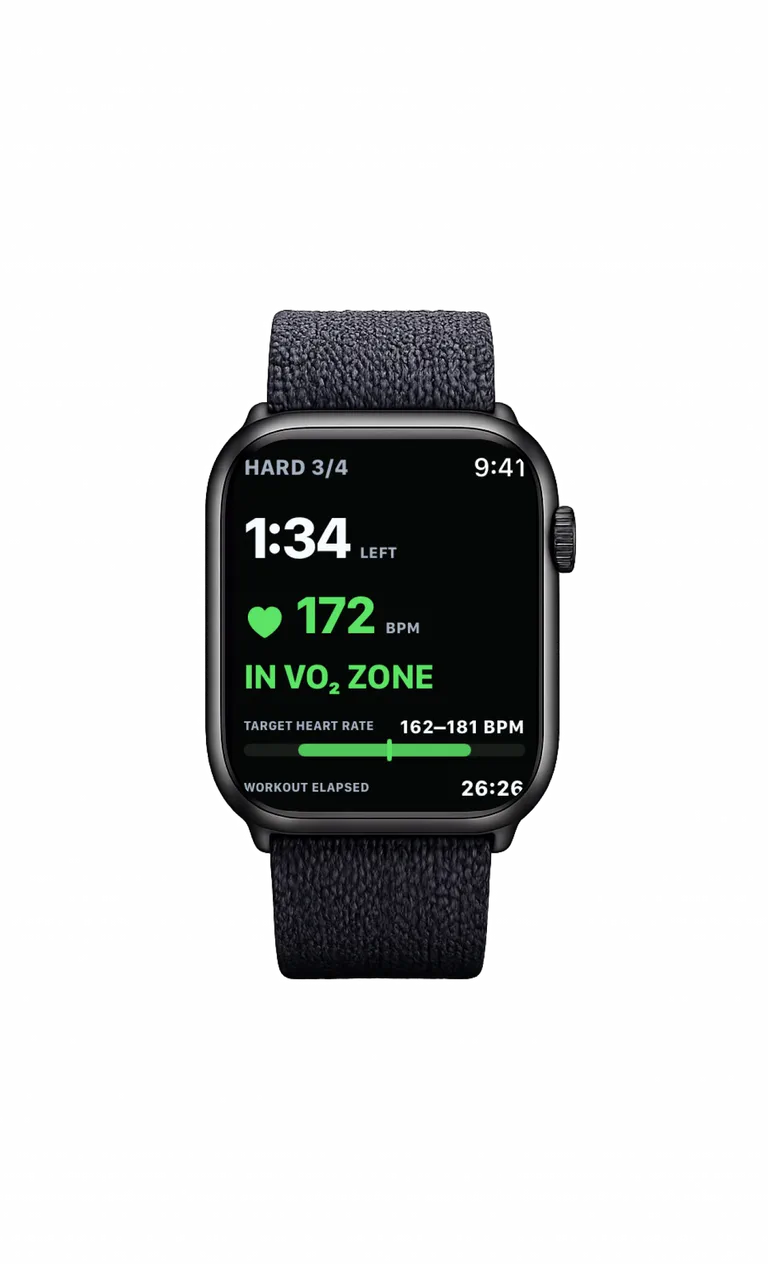
Ramp4x4 loads the complete Norwegian 4×4 session on iPhone and Apple Watch, cues each phase, and coaches your heart-rate target. The free version includes unlimited classic workouts, Watch execution, voice and haptic cues, and a basic summary; Premium adds the multi-week plan and deeper history.
Primary sources
- Apple Newsroom: Apple advances health and fitness capabilities using Apple Intelligence (September 9, 2026).
- Apple Support: Track your cardio fitness levels (updated October 27, 2025).
- Apple: Using Apple Watch to Estimate Cardio Fitness with VO2 max (May 2021).
- Helgerud et al.: Aerobic high-intensity intervals improve VO2max more than moderate training (Medicine & Science in Sports & Exercise, 2007).