Norwegian 4x4 Workout for VO2 Max
Norwegian 4x4: 10-minute warmup, four 4-minute hard intervals targeting 85 to 95% max HR, with 3-minute active recoveries between intervals, followed by a cooldown.
Published June 14, 2026Last updated September 12, 2026By Archline Labs LLCEditorial methodology
The Norwegian 4x4 at a glance
- Structure
- 4 x 4 min hard, with 3 min easy recovery between each
- Hard effort
- 85 to 95 percent of maximum heart rate (aim for 90 percent or higher)
- Recovery
- 60 to 70 percent of maximum heart rate, keep moving
- Warmup / cooldown
- about 10 min easy warmup, 3 to 5 min cooldown
- Total time
- about 35 to 40 minutes
- Frequency
- 2 to 3 times per week; results typically in 6 to 8 weeks
- Best for
- raising VO2 max and cardiorespiratory fitness
Norwegian 4x4 Heart-Rate Zone Calculator
This heart-rate zone calculator gives you the two zones you need to run the Norwegian 4x4 correctly: the hard interval zone (85 to 95 percent of max HR) and the recovery zone (60 to 70 percent of max HR). Enter your age, or a measured max heart rate for a more accurate result. Add your resting heart rate for optional Karvonen (heart-rate-reserve) targets.
Years
Used only if no measured max below
Overrides the formula
Enables Karvonen targets
Hard interval · 85 to 95%
156 to 175 bpm
Hold this for each 4-minute interval
Recovery · 60 to 70%
110 to 129 bpm
Easy effort between intervals
Save your zones and run the workout on Apple Watch. Ramp4x4 recalculates and saves your targets in the app, then guides every warmup, interval, recovery, and cooldown with live heart rate, voice cues, and Watch haptics.
What is the Norwegian 4x4 workout
The Norwegian 4x4 is a high-intensity interval training (HIIT) format built around a simple shape: four hard intervals of four minutes each, separated by easy recovery periods. The hard efforts are run at 85 to 95 percent of your maximum heart rate, hard enough that you are working near the top of your aerobic range, but controlled enough to repeat four times.
It earned the "Norwegian" name because it was developed and studied by exercise physiologists at the Norwegian University of Science and Technology (NTNU) in Trondheim, researchers like Jan Helgerud, Jan Hoff, and Ulrik Wisloff. Their work made the 4x4 one of the most-cited interval protocols in the world, used everywhere from elite endurance sport to cardiac rehabilitation.
People care about it because of one number: VO2 max, the maximum amount of oxygen your body can use during intense exercise. VO2 max is one of the strongest predictors of cardiovascular fitness and long-term health, and the 4x4 is a VO2 max workout that improves it well, because those long, near-maximal intervals keep you at a high percentage of VO2 max far longer than a sprint or a steady jog can.
Jan Helgerud and the Norwegian 4x4 research
Search interest around the Norwegian 4x4 often points back to Jan Helgerud, the NTNU exercise physiologist whose 2007 work helped popularize this interval format. The commonly cited protocol is four 4-minute intervals near 90 to 95 percent of maximum heart rate, with active recoveries between them. Ramp4x4 is not affiliated with Helgerud or NTNU, but the app is built around the same practical structure: warm up, complete four hard intervals, recover actively, and track whether you spent meaningful time near the target zone.
For a deeper look at Helgerud, Wisloff, the VO2 max results, and the caveats, read the dedicated Norwegian 4x4 research guide. If you already know the workout and just need to run it, open the Ramp4x4 timer or get the app on the App Store.
The Norwegian 4x4 protocol, step by step
The Norwegian 4x4 intervals are four 4-minute hard efforts with a 3-minute easy recovery after each. One full session looks like this:
| Phase | Duration | Effort | Heart rate |
|---|---|---|---|
| Warmup | about 10 min | easy, conversational | 60 to 70% HRmax |
| Interval 1 | 4 min | hard | 85 to 95% HRmax |
| Recovery | 3 min | easy, keep moving | 60 to 70% HRmax |
| Interval 2 | 4 min | hard | 85 to 95% HRmax |
| Recovery | 3 min | easy, keep moving | 60 to 70% HRmax |
| Interval 3 | 4 min | hard | 85 to 95% HRmax |
| Recovery | 3 min | easy, keep moving | 60 to 70% HRmax |
| Interval 4 | 4 min | hard | 85 to 95% HRmax |
| Cooldown | 3 to 5 min | easy | under 65% HRmax |
Warmup Hard interval (4 min) Recovery (3 min) Cooldown
A few practical notes
- The recovery is active, not a full stop. Keep moving at an easy pace. The goal is to let your heart rate fall to about 60 to 70 percent, not to come to a standstill.
- The first minute of each interval is "free." It takes 60 to 90 seconds for your heart rate to climb into the target zone, so judge each interval by where your heart rate is in minutes 2 to 4, not in the first 30 seconds.
- Pace so the fourth interval looks like the first. If interval 4 falls apart, you went out too hard. The 4x4 rewards even, repeatable efforts.
- Any modality works: running, incline treadmill, cycling, rowing, elliptical, assault bike, or uphill hiking. Pick something that lets you reach 85 to 95 percent safely.
Heart-rate targets for the Norwegian 4x4
The 4x4 is defined by heart rate, which is what makes it scalable to any fitness level. First, estimate your maximum heart rate (HRmax). A quick estimate is the Tanaka formula, which is more accurate across ages than the old "220 minus age" rule:
- Tanaka (recommended): HRmax is about 208 minus (0.7 x your age)
- Classic: HRmax is about 220 minus your age
- Best of all: a measured max from a hard test, or a max you have actually seen on your monitor.
Then apply the zones. Here are the interval (85 to 95 percent) and recovery (60 to 70 percent) targets for common estimated max heart rates:
| Estimated HRmax | Interval zone (85 to 95%) | Recovery (60 to 70%) |
|---|---|---|
| 170 bpm | 145 to 162 bpm | 102 to 119 bpm |
| 180 bpm | 153 to 171 bpm | 108 to 126 bpm |
| 190 bpm | 162 to 181 bpm | 114 to 133 bpm |
| 200 bpm | 170 to 190 bpm | 120 to 140 bpm |
Do not have your numbers memorized? Use the calculator near the top of this guide, or the dedicated Norwegian 4x4 heart-rate calculator, to get your exact targets.
Try the 4x4 interval flow
Run a short, sped-up demo of the Norwegian 4x4 structure: warmup, four hard intervals, active recoveries, and cooldown. The demo uses simulated heart rate so you can see how Ramp4x4 guides each phase. In the app, your Apple Watch provides live heart-rate data, haptics, and workout cues. For more, see the dedicated Norwegian 4x4 timer page.
That is the full Norwegian 4x4 shape. The real workout runs on your Apple Watch with live heart rate, haptics, and cues.
Explore the complete app previewHeart rate shown here is simulated for demonstration only. In the app, your real heart rate comes from Apple Watch.
Want to see the complete app first?
Explore every iPhone and Apple Watch screen in the fully unlocked browser preview, then install Ramp4x4 for live heart rate, haptics, and real workout summaries.
VO2 Max Estimate Calculator
A heart-rate zone calculator tells you how hard to go so you run the Norwegian 4x4 correctly. A VO2 max calculator does something different: it gives you a rough fitness number you can track over time. The field tests below are estimates, not lab measurements, so the trend matters more than any single value.
Wearables add their own estimates too. Apple Watch, Garmin, WHOOP, and Oura each calculate VO2 max with their own methods and assumptions, so their numbers often disagree with each other and with field tests. Pick one source and compare your trend over weeks rather than chasing a single number.
Pick the test you have data for
As far as you can go in 12 min
Units for the distance above
Whole minutes
0 to 59 seconds
Measured max, or copy from above
Beats per minute at rest
Estimated VO2 max
enter values
Rough estimate, not a lab measurement
Heart rate is a guide, not the goal
It is easy to treat the heart-rate target as a pass or fail test. It is not. Heart rate is a guide that helps you pace the Norwegian 4x4, and it has a built-in delay.
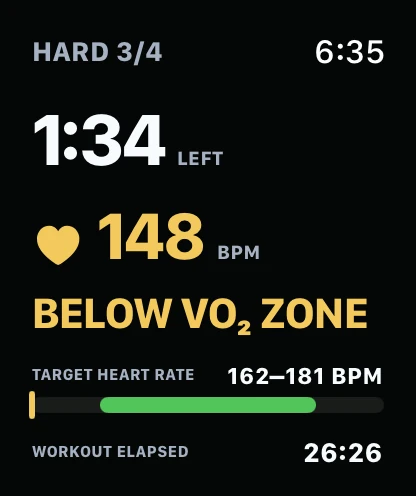
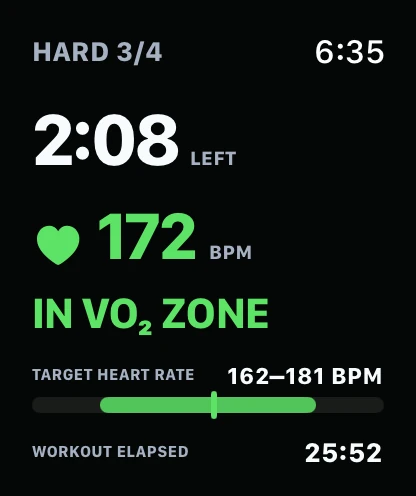
When you start a hard interval, your heart rate does not jump to 90 percent instantly. It takes roughly 60 to 90 seconds to climb into the zone, so the first minute of each interval can look too low even when your effort is exactly right. Push at a hard but repeatable effort and let your heart rate catch up. By minutes 2 to 4 it should settle near the target.
So watch the trend, not a single number. The goal is to spend controlled time near the intended intensity across the whole interval, not to hit an exact beat at every second. Ramp4x4 is built around this idea: it shows your live heart rate against the target zone as a coaching aid, so you can pace the session and stay near the right intensity rather than chasing the number.
Why use Ramp4x4 instead of Apple Fitness or a generic HIIT timer?
You can absolutely run a Norwegian 4x4 with Apple Fitness, a generic HIIT timer, a treadmill timer, or a plain stopwatch. Plenty of people do. The reason Ramp4x4 exists is that those tools make you build and babysit the workout yourself, and Ramp4x4 does not.
Ramp4x4 is a purpose-built Norwegian 4x4 timer. Here is what it handles for you:
- One-tap Norwegian 4x4 setup, with the warmup, four hard intervals, active recoveries, and cooldown already built in.
- Target heart-rate zones calculated for you, so you are not doing math mid-warmup.
- An Apple Watch-first workout view, so the session lives on your wrist.
- Voice cues and haptics that tell you when to push and when to ease off.
- Live heart-rate zone feedback as a pacing guide, not a pass or fail judge.
- Progress, history, and VO2 max trends so you can see the work add up.
- Less clock-watching during the hard intervals, because the app tracks the phases for you.
This is not about replacing Apple Fitness. If a stopwatch already works for you, keep using it. Ramp4x4 is for people who do this workout often and want it to be easier to follow.
Common Norwegian 4x4 mistakes
The protocol is simple, but a few mistakes quietly blunt the results:
- Going too hard on interval 1. The most common error. If you sprint the first interval you will fade, and the average intensity across all four drops. Start at a pace you can hold for all four; the workout is judged by the whole set, not the first rep.
- Not getting hard enough. The flip side: cruising at 80 percent is not a 4x4. The benefit is in that 90 to 95 percent window. If your heart rate never climbs near the top, you are doing a tempo workout, not VO2 max work.
- Resting too easy or too hard. Standing still lets your heart rate crash and makes the next interval feel like a cold start; jogging too hard means you never recover. Keep recoveries genuinely easy but moving.
- Intervals that are too short—or paused below target. Four minutes matters because heart rate takes time to rise. In our N=1 analysis of 28 work intervals, the median sustainable ramp was 2:11. See why heart-rate gating creates a different workout.
- Doing it too often. This is a hard stimulus. Two to three sessions a week with easy days between is plenty; daily 4x4s lead to fatigue, not faster gains.
- Watching the clock instead of training. Manually tracking nine phases and your heart rate at the same time is miserable. A dedicated timer that cues each phase frees you to just hit the effort.
How many times a week should you do Norwegian 4x4?
The short answer is: less often than your motivation might suggest. Norwegian 4x4 is a hard VO2 max session, so most people should place it like a key workout, not an everyday habit.
- Beginners: start with one session per week, then add easy aerobic work on other days.
- Most consistent runners, cyclists, or gym users: two sessions per week is a strong default.
- Well-trained people who recover well: three sessions per week can work, but only if the rest of the week stays easy enough.
Ramp4x4 is built around this cadence: start a guided session, see whether you actually spent time near 90% max HR, then use your history to decide whether the next hard workout should be soon or whether you need more easy work first.
Norwegian 4x4 for beginners
You do not need to be an athlete to use the Norwegian 4x4 structure, but it is an intense workout, so ease in rather than diving into four all-out intervals on day one.
A sensible start:
- Build an easy aerobic base first. Comfortable, conversational cardio a few times a week prepares your body for hard intervals.
- Start conservatively. Try two or three intervals before working up to the full four, and keep the hard efforts hard but controlled, not all-out sprints.
- Do fewer hard sessions at first. One Norwegian 4x4 per week, with easy cardio on other days, is plenty early on.
- Do not make 4x4 your only training. Mix hard sessions with easy aerobic work and rest; the gains come from the combination, not from hammering intervals every day.
- Listen to your body. Stop if something feels wrong, such as chest pain, dizziness, or unusual shortness of breath.
If you have a heart condition, high blood pressure, or any medical concern, talk to your doctor before doing near-maximal intervals. This page is educational and not medical advice.
Using Norwegian 4x4 with Apple Watch, Garmin, Oura, WHOOP, or a chest strap
Any of these devices can support a 4x4, but they are good at different things. Here is how they fit.
Apple Watch
Apple Watch is useful for live heart rate during intervals, saving sessions to Apple Health, and tracking workout history and Apple Watch VO2 max trends over time. Ramp4x4 turns Apple Watch into a focused interval timer for the Norwegian 4x4: the watch shows your current phase, the timer, and your live target zone while your iPhone keeps your history and trends. Here is how to run 4x4 intervals on Apple Watch with clear phase changes and haptics.
Garmin
Garmin watches give live heart rate, a max heart rate reading, Garmin VO2 max trend estimates, and solid GPS for outdoor running or cycling sessions. If you train with Garmin, use it for live heart rate during the intervals and to watch your VO2 max trend across weeks. Ramp4x4 runs on iPhone and Apple Watch and does not connect to Garmin devices.
Chest heart-rate monitor
Chest straps read the heart's electrical signal directly, so they usually track sudden heart-rate changes faster and more accurately than wrist sensors, which can lag when your heart rate jumps at the start of a hard interval. For accurate data during the 4-minute hard intervals, a chest heart rate monitor is the better tool, and many watches (including Apple Watch and Garmin) can pair with one.
Oura and WHOOP
Oura and WHOOP are best for sleep, recovery, readiness, and longer-term trend context rather than live interval pacing. They are great for deciding whether today is a good day to train hard, but they are not ideal as your primary monitor during a Norwegian 4x4. Pair them with a watch or chest strap for the workout itself.
Norwegian 4x4 vs HIIT
Norwegian 4x4 is a specific HIIT protocol, not a catch-all term for hard intervals. "HIIT" covers everything from 20-second sprints to 1-minute bike efforts. The 4x4 is deliberately longer: 4-minute efforts at 85 to 95 percent of max heart rate, with 3-minute recoveries. Those longer intervals are what keep you near VO2 max long enough to drive the adaptation, which is why the 4x4 is a go-to when the specific goal is raising VO2 max rather than general conditioning.
Norwegian 4x4 vs Zone 2
Zone 2 is low-intensity aerobic base work: an easy effort you can sustain for a long time while holding a conversation. Norwegian 4x4 is the opposite end of the scale, a hard VO2 max stimulus. The zone 2 vs VO2 max intervals question is not really either-or. Zone 2 builds the aerobic engine with high volume and low stress, while the 4x4 sharpens the top end. A common approach is mostly easy Zone 2 work through the week with one or two Norwegian 4x4 sessions added on top. They complement each other.
Norwegian 4x4 for running, cycling, rowing, treadmill, and assault bike
The 4x4 works on anything that lets you reach 85 to 95 percent of max heart rate. A few modality-specific tips:
- Running: do not sprint the first interval. Settle into a hard but repeatable pace so interval four still holds together.
- Treadmill: raise the incline to reach your target heart rate without needing risky high speeds. Incline lets you hit the zone safely; see the dedicated Norwegian 4x4 treadmill speed and pacing guide.
- Cycling: use resistance and a steady cadence to keep the effort smooth rather than surging and stalling.
- Rowing: hold your form as fatigue builds. Keep the stroke strong and controlled instead of getting short and frantic.
- Assault bike: do not blow up in the first 90 seconds. Heart rate climbs fast here, so build into the effort and hold it.
Running the Norwegian 4x4 with a timer
You can run a 4x4 with any interval timer: set 10 minutes, then alternate 4 minutes hard and 3 minutes easy four times, then a cooldown. The catch is doing that and watching your heart rate stay in the 85 to 95 percent zone, in real time, while you are working hard. Ramp4x4 is a guided 4x4 interval timer built to handle exactly that.
Ramp4x4: a guided Norwegian 4x4 timer for iPhone and Apple Watch
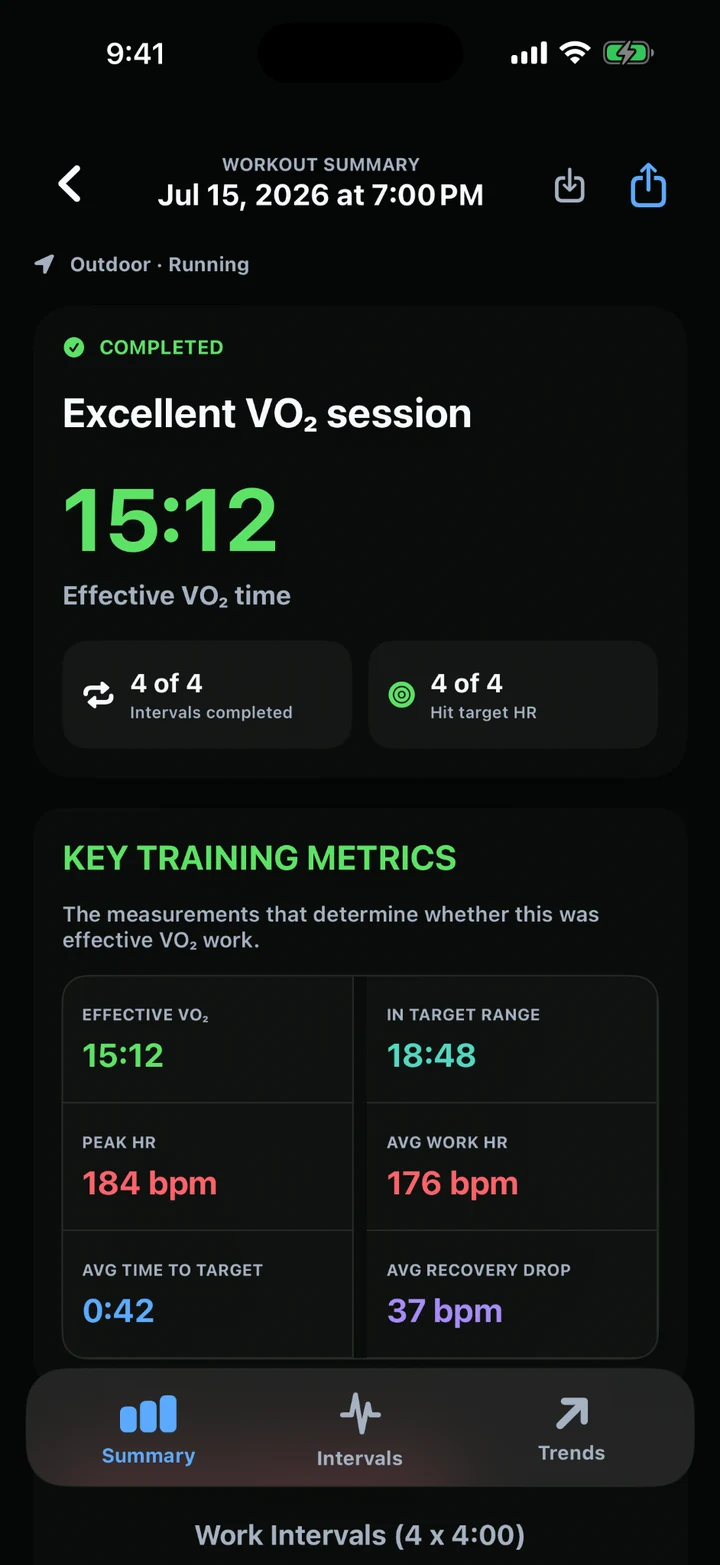
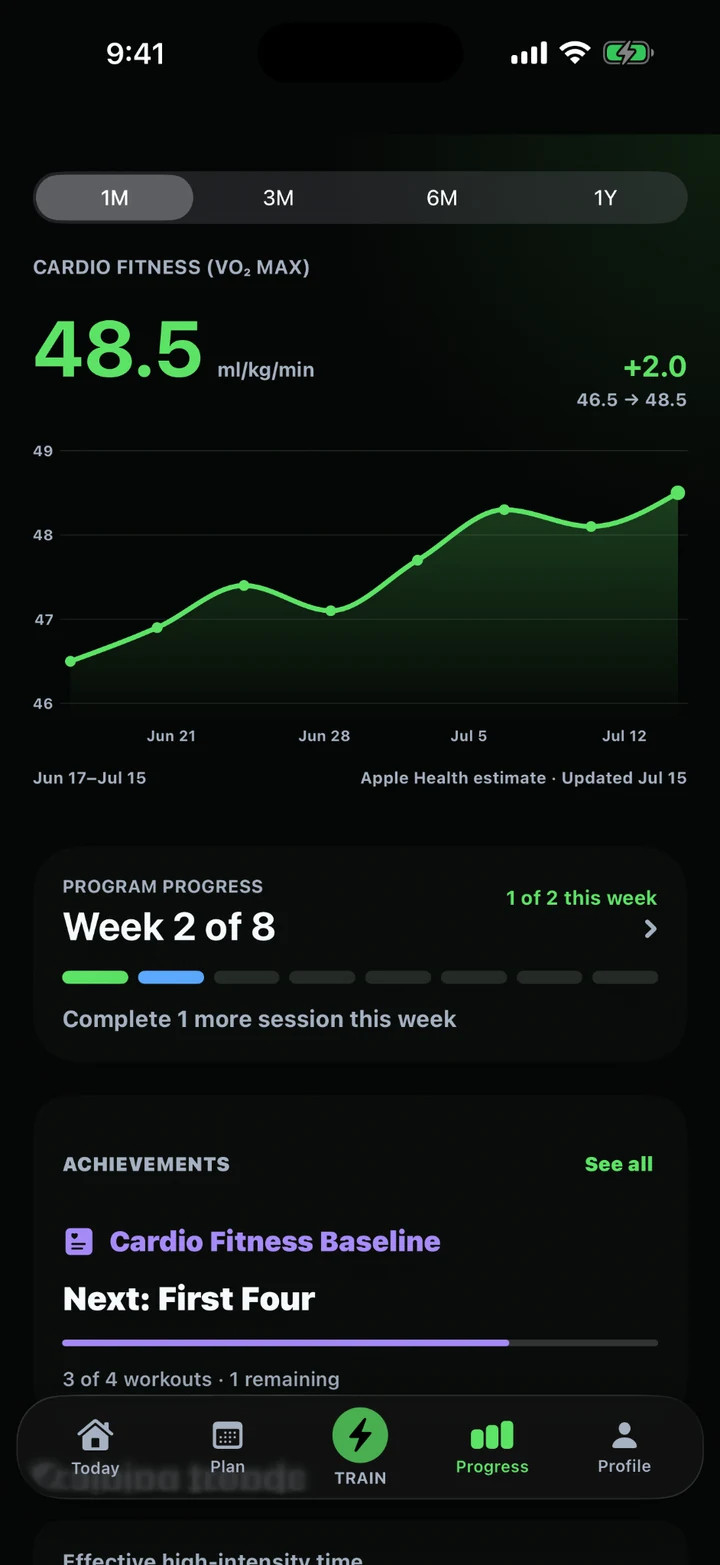
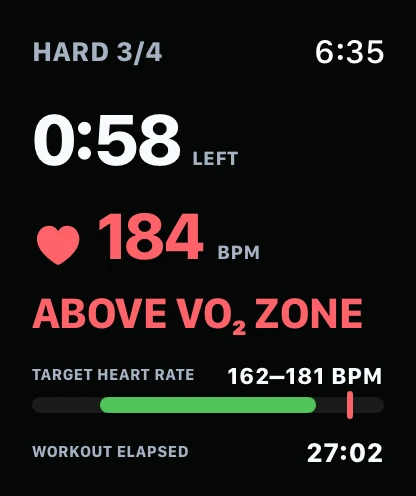
Ramp4x4 is a guided Norwegian 4x4 timer for iPhone and Apple Watch. It calculates target zones, cues every phase, shows live heart-rate feedback, and tracks your progress so you can focus on the workout instead of managing a stopwatch. A paired Apple Watch runs the session with voice cues and haptics; the iPhone keeps your history and VO2 max trends.
What the workout looks like
On the Apple Watch
The evidence behind the Norwegian 4x4
The 4x4 is not gym folklore. It comes out of controlled studies, and that is a big part of why it spread:
- Helgerud et al. (2007) compared training methods in healthy men over 8 weeks. The 4x4 group (four 4-minute intervals at about 90 to 95 percent HRmax, 3 times per week) improved VO2 max by about 7.2 percent, substantially more than volume-matched moderate continuous training, which produced little to no VO2 max change.
- Wisloff et al. (2007), published in Circulation, tested the 4x4 in post-infarction heart-failure patients over 12 weeks. Aerobic interval training raised VO2 peak by 46 percent, versus 14 percent for moderate continuous training, alongside improvements in heart structure and function. That study was medically supervised; see the disclaimers above.
Like any single protocol, the 4x4 has its debates, and it is not magic. Consistency over weeks is what moves VO2 max. But as a repeatable, time-efficient way to spend real minutes near your aerobic ceiling, it has held up well.
Frequently asked questions
What is Norwegian 4x4?
It is a high-intensity interval workout: four 4-minute hard efforts at 85 to 95 percent of your maximum heart rate, each followed by 3 minutes of easy active recovery, with a warmup and cooldown around them. It is a popular, well-studied way to build VO2 max.
What is the Norwegian 4x4 protocol?
About 10 minutes of easy warmup, then 4 minutes hard and 3 minutes easy repeated four times, then a short cooldown. Hard intervals target 85 to 95 percent of max heart rate; recoveries drop to about 60 to 70 percent. A full session takes roughly 35 to 40 minutes.
Is Norwegian 4x4 good for VO2 max?
Yes. It is one of the most studied interval formats for improving VO2 max, because the 4-minute efforts keep you near your aerobic ceiling longer than short sprints. In controlled studies it produced larger VO2 max gains than steady moderate training. It is one tool, not a magic bullet; consistency over weeks is what moves the number.
Why use Ramp4x4 instead of Apple Fitness?
You can run a 4x4 with Apple Fitness, a generic HIIT timer, or a stopwatch. Ramp4x4 is purpose-built for this one workout: one-tap setup of the warmup, four intervals, recoveries, and cooldown, target zones calculated for you, an Apple Watch-first view, voice cues and haptics, live heart-rate feedback, and progress and VO2 trends, so you spend less time watching the clock.
Is heart rate the goal of Norwegian 4x4?
No. Heart rate is a guide, not the goal. It lags at the start of each hard interval, so the first minute may not be in the target zone yet even when your effort is right. Use heart rate to pace and to watch the trend across the interval, not as a pass or fail on any single second.
What heart rate should I hit?
Aim for 85 to 95 percent of your maximum heart rate during each 4-minute interval, ideally drifting up to 90 percent or higher by the end. Recover at about 60 to 70 percent. Use the heart-rate zone calculator on this page for your exact numbers.
Can beginners do Norwegian 4x4?
Beginners can use the structure, but start conservatively. Build easy aerobic cardio too, consider fewer hard sessions at first, and do not treat 4x4 as your only training. The effort is high, so progress gradually and check with your doctor if you have any health concern.
How many times a week should I do Norwegian 4x4?
Most people should treat it as a hard workout, not a daily routine. One session per week is enough for many beginners. Two sessions per week is a strong default if you are specifically training VO2 max, and three is the upper end for people who recover well and keep the rest of their training easy.
Is Norwegian 4x4 better than Zone 2?
They solve different problems. Zone 2 builds your aerobic base at low intensity and high volume; Norwegian 4x4 is a harder VO2 max stimulus. Most balanced plans use both rather than choosing one.
Can I use Apple Watch?
Yes. Apple Watch gives live heart rate, history, and VO2 max trends, and Ramp4x4 runs on iPhone and Apple Watch with guided phase timers, voice cues, haptics, and live targets on your wrist. Workouts save to Apple Health.
Can I use Garmin?
You can use a Garmin watch for live heart rate, max heart rate, VO2 max trends, and outdoor running or cycling. Ramp4x4 itself runs on iPhone and Apple Watch and does not connect to Garmin devices, so on Garmin you would pace the 4x4 yourself.
Do I need a chest strap?
No, but a chest strap tends to track fast heart-rate changes more accurately than a wrist sensor, which can lag during hard intervals. If you want precise interval data, a chest strap helps; otherwise a watch is fine for pacing by effort and zone.
Is Oura or WHOOP useful?
They are most useful for sleep, recovery, readiness, and trend context rather than as your live interval screen. Use them to decide when to train hard, and use a watch or chest strap to pace the intervals themselves.
What is the best Norwegian 4x4 timer app?
Any interval timer set to 10 minutes, then 4 minutes hard and 3 minutes easy four times, then a cooldown will run the structure. Ramp4x4 for iPhone and Apple Watch is purpose-built for the Norwegian 4x4 and adds calculated target zones, phase cues, voice and haptics, and live heart-rate feedback so you can focus on the effort.
References and further reading
- Helgerud J, Høydal K, Wang E, et al. Aerobic high-intensity intervals improve VO2max more than moderate training. Medicine & Science in Sports & Exercise. 2007;39(4):665–671. DOI: 10.1249/mss.0b013e3180304570.
- Wisløff U, Støylen A, Loennechen JP, et al. Superior cardiovascular effect of aerobic interval training versus moderate continuous training in heart failure patients. Circulation. 2007;115(24):3086–3094. DOI: 10.1161/CIRCULATIONAHA.106.675041.
- Tanaka H, Monahan KD, Seals DR. "Age-predicted maximal heart rate revisited." Journal of the American College of Cardiology, 2001. PubMed