Should the Norwegian 4x4 Clock Stop When Your Heart Rate Drops?
We built a timer that paused below the target zone. Then we removed it. Here is the protocol logic and field data behind that decision.
Published July 19, 2026Last updated July 19, 2026By Archline Labs LLCEditorial methodology
Direct answer: No. The Norwegian 4x4 prescribes four 4-minute effort intervals. The heart-rate ramp at the start is part of that timed interval, not time the clock should delete. Gating the clock on heart rate creates a longer, less predictable workout that is not the fixed protocol evaluated in the cited research. Measure the ramp; do not erase it.
Same effort, two clocks
What changes when heart rate controls the timer
Fixed interval The protocol
4:00 total effortEvery second remains inside the interval.
HR-gated timer A different workout
Ramp + 4:00 above targetTotal effort expands with the ramp.
What the protocol actually prescribes
The Norwegian 4x4 comes from the Helgerud and NTNU line of research: four intervals of four minutes at roughly 85–95% of maximum heart rate, separated by three minutes of active recovery. In the landmark eight-week study, this structure improved VO2 max more than moderate continuous training in the study population.
The detail that matters here is that the four minutes were measured on the clock, not on the heart-rate trace. Participants started each interval, heart rate climbed during the timed effort, and the interval ended four minutes after it began. NTNU's current guidance explicitly notes that reaching 90% during the first interval is sufficient and that subsequent intervals can take one to two minutes to enter the target range.
Heart rate is a response to effort, and it does not jump instantly when workload changes. Your muscles can already be doing hard work while the measured heart rate is still rising. The fixed duration was evaluated with that response delay inside it.
What our field data shows about the ramp
We analyzed 3,513 heart-rate readings across 28 work intervals from repeated Norwegian 4x4 running sessions. The full methods and sanitized data are available in the original heart-rate analysis.
- The median interval took 2 minutes 11 seconds to sustainably reach its lower target threshold.
- Observed valid ramp times ranged from 1:28 to 3:47.
- 25 of 28 intervals reached target; the three that did not were in intervals three and four.
- Later intervals did not ramp faster in this small sample despite an elevated starting heart rate.
28 real work intervals
Time to sustainably reach the lower target
- Reached target
- Did not sustainably reach target
- Median
View the accessible data table
| Interval | Reached | Median ramp |
|---|---|---|
| 1 | 7 of 7 | 2:05 |
| 2 | 7 of 7 | 2:15 |
| 3 | 6 of 7 | 2:07 |
| 4 | 5 of 7 | 2:11 |
Gating creates a different workout
Run those observed ramps through a heart-rate-gated clock. Adding the 2:11 median ramp to every interval would stretch the hard-work portion from 16:00 to about 24:44. If every interval had a 3:47 ramp—the slowest valid ramp observed in this dataset—the same calculation reaches about 31:08.
Those are illustrations, not prescribed workloads or observed complete gated sessions. They show the central problem: a gate converts day-to-day response time into extra work. Heat, hydration, pacing, fatigue and sensor behavior can all change the total load even when the athlete intended to repeat the same session.
Calculated comparison
Four intervals under three timing rules
The comparability argument cuts the other way
The appeal of gating is consistency: make every session contain exactly 16 minutes above threshold, then compare the outcomes. But fixing time above threshold does not fix the workout, because the work before the threshold still happened and still cost something. A slow-ramp gated session contains more total effort than a fast-ramp gated session; the gate hides that difference instead of standardizing it.
Fixed four-minute intervals are the comparable unit: same duration, same recovery and the same structure as the cited protocol. Ramp time, time in zone, peak heart rate and recovery drop can then be interpreted as responses to a constant stimulus.
The ramp is a signal, not junk time
The ramp can be one of the most informative measurements in a repeatable session. Its direction over multiple workouts may reflect pacing, freshness, heat, sensor source and cardiovascular response. A downward trend at comparable effort can be useful to investigate alongside pace or power, perceived effort and conditions; it is not proof of adaptation by itself.
The three missed thresholds in our dataset were all in intervals three and four. That back-half pattern is visible precisely because the work interval stayed fixed. A gated clock could keep stretching those efforts or end without a clean comparison.
Illustrative—not measured data
One way a ramp-time trend might look
When a gated timer might make sense
Heart-rate-gated intervals can be legitimate when the prescription is explicitly to accumulate a set amount of time above a threshold. If your goal is “16 minutes above 85%,” a gated timer can automate that—provided you understand that you are choosing a longer, harder, non-4x4 session whose total load floats with your ramp speed.
What a gated clock should not be presented as is a more faithful Norwegian 4x4. It is a different training rule.
How Ramp4x4 handles it instead
Ramp4x4 keeps the intervals fixed at 4:00 and measures what happens inside them: time to reach target, time in range, time above the upper bound, whether each interval reached target and the one-minute recovery drop. The stimulus stays constant; the measurements carry the information.
This is also why a plain timer is useful but incomplete. It can run the structure, while live heart-rate tracking and a Workout Summary explain what happened inside it.
Real Ramp4x4 screen
Fixed intervals. Measured response.
The Interval Analysis view compares each response curve with the target line, reports ramp time, and makes a late-session miss visible instead of stretching the clock.
Explore the Workout Summary preview →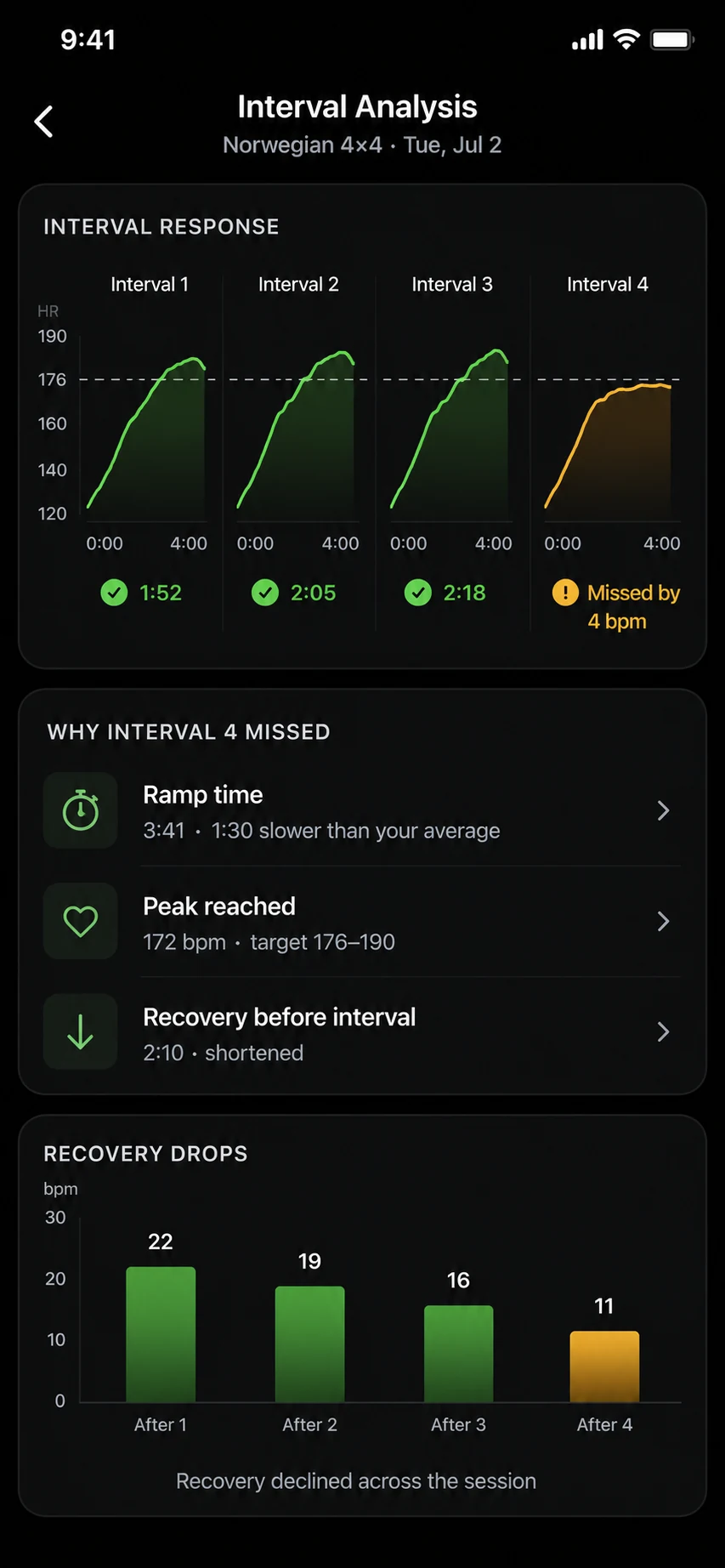
What this article does not claim
This analysis combines one person's field data (N=1, 28 intervals) with the published protocol literature. It does not show that gated timers harm outcomes, and it does not establish that no useful gated protocol can exist. It does not apply to deliberate zone-accumulation training, which is a different prescription. Individual heart-rate dynamics vary, and wrist and chest sensors differ in lag and dropout. This is training interpretation, not medical advice.
Reviewed sources
- NTNU Cardiac Exercise Research Group: 4×4 structure and heart-rate guidance.
- Helgerud et al. Aerobic high-intensity intervals improve VO2max more than moderate training.
- Fuller et al. Reliability and validity of commercially available wearable devices for measuring heart rate.
- Apple Support: getting the most accurate heart-rate measurement from Apple Watch.
- Archline Labs: sanitized ramp-time dataset and complete methodology.
Train the protocol. See the response.
Track your own ramp, zone time and recovery
Ramp4x4 guides the fixed Norwegian 4x4 on iPhone and Apple Watch, then shows what each interval accomplished. The complete basic 4×4 workout is free.
Available for iPhone and Apple Watch. Basic 4×4 workout free; optional premium features available.
 Scan with your iPhone